
Cashing in on strategically driven data-based techniques is critical to extracting insights from the massive volume of data flowing in a business. Both data science and business intelligence stand out as two bedrocks that allow businesses to drive value from raw data.
While both disciplines deal with data manipulation and analysis, they differ in objectives, methodologies, and applications.
What is Data Science
Data science is an interdisciplinary study area that uses different advanced technologies and analytics tools to extract value from data sets and create forecasts based on them.
An example of structured data can be a relational database that contains customer details such as names, addresses, purchase history, etc. On the other hand, unstructured data include emails, social media messages, images, video content, etc.
At the core of data science are statistical analytics, big data, machine learning, prescriptive and predictive analytics, data mining, and data visualisation that aims at facilitating decision-making and resource optimisation.
By integrating domain-specific knowledge with coding languages and analytical expertise, data scientists dive deeper into historical data to identify patterns, trends, and customer demands in today’s dynamic business landscape.
The process involves collecting data from both structured, semi-structured and unstructured sources and storing it securely for processing.
Next up is data preparations which consists of cleaning data and transforming it into a standard format. Data cleaning upholds data quality and data integrity while also ensuring no inconsistent and inaccurate data is fed into the analytics system. Then, the prepared data is explored to identify and comprehend different patterns, trends, and various market dynamics.
The incorporation of various statistical methods and data visualisation tools aided by graphs and charts, allows stakeholders to understand data better. Next comes the experimentation and prediction stage, where statistical methods, machine learning and artificial intelligence algorithms are used to construct predictive models to extract insights from data and make accurate predictions on trends, patterns, and market dynamics.
While various statistical methods facilitate data interpretation, advanced data mining techniques help extract information or uncover insights from massive troves of complex data. Data analysts then present these insights as visuals that impact decision-making.
Business Intelligence
Business Intelligence is a disruptive approach to implementing technology-driven strategies and techniques to collect, and analyse data from all sources – external and internal – a business exists.
External data sources can be social media feeds, public APIs, etc. On the other side, internal data source comprises data generated by a business itself, such as marketing and sales data, data stored in a CRM system. etc.
At the core of advanced BI are data integration, data warehousing, and descriptive analytics which help businesses augment their decision-making.
The process starts with business analysts collecting data from various sources, followed by data integration to ensure no inconsistent, inaccessible, or inaccurate data is fed into the analytics system. The integrated data is transformed into a standard format and is stored in data warehouses for analysis.
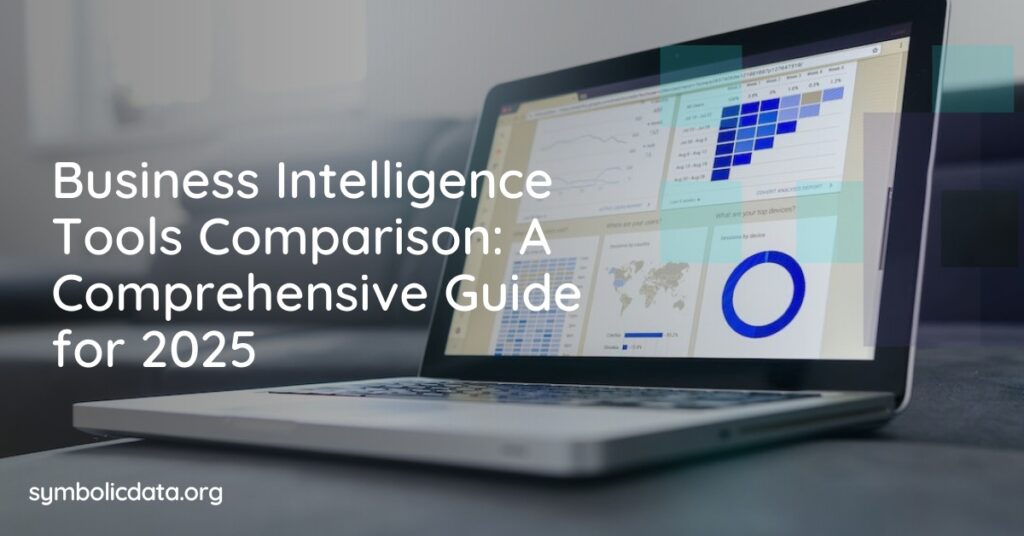
Advanced BI tools, equipped with real-time analytics and integration capabilities are then used to perform data analysis, pinpoint trends, and extract insights from it. Once analysis is done, data can be easily visualised using customisable dashboards and data visualisation tools.
Beyond powering real-time dashboards, modern BI platforms are reshaping who has access to data insights across the enterprise. Self-service tools and intuitive visualizations remove the traditional dependency on dedicated analysts, enabling business users at every level to explore data independently and act on findings with confidence. This shift toward data democratization in business intelligence ensures that stakeholders across departments — from marketing to operations — can engage directly with the metrics and KPIs most relevant to their roles, accelerating informed decision-making organization-wide.
Selecting the right BI platform is a critical decision that directly shapes how effectively these analytical capabilities can be deployed. Organizations must weigh factors such as licensing costs, scalability, integration flexibility, and vendor support before committing to a solution. A thorough open-source vs commercial BI solutions comparison can clarify which approach best aligns with an organization’s technical infrastructure, budget constraints, and long-term data strategy — ultimately determining how seamlessly real-time analytics feed into the dashboards stakeholders rely on daily.
With so many vendors competing for enterprise budgets, narrowing the field requires a structured evaluation of each platform’s strengths and limitations. Tools like Power BI, Tableau, Looker, and Qlik each offer distinct advantages depending on an organization’s data infrastructure, team skill sets, and reporting demands. A thorough BI tools comparison by features and vendor can help decision-makers weigh cost structures, deployment flexibility, and ecosystem compatibility side by side — laying the groundwork for selecting a platform whose dashboarding and KPI-tracking capabilities will genuinely serve stakeholder needs.
The dashboard and reporting features with advanced BI help stakeholders track key performance indicators (KPIs) and share reports to make informed business decisions.
Understanding why BI matters goes well beyond simply having pretty dashboards on a screen. When organizations invest in robust BI systems, they gain a competitive edge through faster decision-making, reduced operational inefficiencies, and a clearer view of where the business is headed. The importance of business intelligence in organizations spans everything from improving customer experiences to identifying cost-saving opportunities before they slip away. Recognizing this value sets the stage for a deeper question — one that many professionals find themselves asking: how does BI actually compare to data science, and are the two really that different?
Both BI and data analytics aims to help gain insights from your data, identify trends and augment decision-making that keep ROI rolling in the business. But is there any difference between business intelligence and data science?
Data Science Vs. BI
Business intelligence and data science are often used interchangeably; however, business intelligence is different from data science.
To understand where these two disciplines diverge, it helps to start with a clear picture of the professionals who occupy each field. On the business intelligence side, a Business Intelligence Analyst role and responsibilities center on transforming raw organizational data into structured reports, dashboards, and actionable insights that guide day-to-day and strategic decision-making. These professionals work closely with stakeholders across departments, translating business questions into data queries and presenting findings in formats that non-technical audiences can readily act upon.
While BI experts deal with business-related issues such as ROI, resource allocation and optimisation, etc., data science professionals help dig deeper into how various social, geographical, and economic factors impact business outcomes. Let’s have a dive into the differences between BI and data science:
- Focus: At the core of BI is descriptive historical data analysis and reporting that allows businesses to get a better understanding of data of the past events. It gives insight into past performance, and based on it, helps understand present trends. It’s great to understand what has happened in the past. On the other hand, by using predictive and prospective data modelling, data science aims to predict future trends and patterns.
- Tools: Pre-built customisable reporting, dashboard, and visualisation come with business intelligence tools to make data insights easily understandable by all business users, regardless of their technical expertise. Data science platforms, on the other hand, are more sophisticated systems and require technical and coding expertise.
- Data Size: BI tools mainly deal with comparatively smaller structured datasets stored in data repositories. On the other hand, data science tools are designed to process large, complex datasets of structured, unstructured, and semi-structured data.
- Techniques: While BI tools operate based on reporting, data aggregation, and data visualisation techniques, data science leverages more advanced ML algorithms, and predictive and statistical modelling.
- The complexity of analysis: Data science involves more complex analysis than business intelligence, and requires a deeper understanding of statistics, mathematics, and computer science.
- Flexibility: With BI tools, you need to preplan the data sources from where you would collect and process data. Data science offers more flexibility as you can add data sources according to your needs.
- Storage: In data science, real-time data streams are distributed across clusters for rapid analysis and data processing. It means that data scientists can work with continuously updating data to extract insights immediately and make informed decisions on time.
Leveraging real-time clustering facilitates the management of high-velocity dynamic data, while also enabling real-time data analytics, predictive modelling, and data monitoring. In BI, data is stored in data warehouses.
While traditional data warehouses don’t support real-time clustering, advanced data warehouses, and cloud-based systems offer capabilities for near-real-time data analytics, integration, and processing to accelerate decision-making. - Scope: BI focuses on operations within the sales or marketing departments and helps extract insights into their functions. On the other hand, from supply chain optimisation to user segmentation – data science has far-reaching applications.
BI targets to facilitate performance tracking and monitoring by making reporting and data visualisation easily accessible. On the other hand, data science leverages predictive models and complex algorithms to drive innovation organistaion-wide. - Outputs: The outputs of a BI initiative are dashboards, reports, and data visualisation while data science produces algorithms and advanced predictive models.
- Cost: Data science leverages more advanced and high-end tools, making it more expensive than BI. In short, the capital and operation costs data science requires are higher than what BI needs.
Despite the differences, both have some similarities. For example, both data scientists and business analysts take a data-centric approach and collect, consolidate, and process data to augment business decisions.
They share the same target – driving organisational success by making business processes more data-based. Again, data analytics tools, such as Tableau, and Power BI, and programming languages like Python, R, etc., are used in both processes. However, the application of these tools may greatly vary.
Data Science Vs. Business Intelligence: Which One to Choose for Your Business
Business intelligence vs data science which one would better choose your businesses depends on a slew of factors – size and business specifications, team expertise, data complexity, etc.
For example, if your business has no budget constraints and requires a scalable system that can scale as your business grows, uncover hidden trends and patterns, and deal with highly complex data sets, data science can offer you the best bang for the buck.
In addition, for in-depth and long-term strategic insights into various business aspects, choose data science tools. The advanced technologies used in data science are great at identifying new business opportunities. Businesses like healthcare, finance, IT, and telecommunication frequently use data science tools to analyse complex data sets.
On the other hand, business intelligence better suits comparatively smaller businesses that need real-time performance tracking to drive operational efficacy. For a business that generates a smaller amount of data, and relies on simple data analytics, visualisations, monitoring, and reporting, using BI is sufficient.
Businesses such as retail, financial institutions, manufacturing, etc. use BI tools for reporting, data visualisation, dashboarding, and ad-hoc querying.
To wrap up, both business intelligence and data science aim to extract and maximise value from your business data. However, before you make a choice, make sure you consider the aforementioned facts.

- Managed RabbitMQ Hosting: 5 Platforms Ranked by Backpressure Handling, Not Peak Throughput - August 20, 2026
- Automating Tax Compliance: The Infrastructure for Modern Accounting Teams - August 15, 2026
- Best CAPA Software for Manufacturers 2026 - August 11, 2026